In response to growing public interest regarding the Rail Baltica consolidated rail procurement, RB Rail, on behalf of all Rail Baltica project implementers in the Baltics, provides additional clarification on the structure, purpose, and pricing principles of the procurement. The aim is to explain the consolidated procurement system jointly approved by all three Baltic states, and why direct comparisons with individual or “spot” procurements, including the recent rail procurement by AS “Latvijas dzelzceļš,” are not possible.
Main objective of consolidated procurement
The primary objective of consolidated procurement is to ensure a predefined and stable price for a massive, long-term, predictable volume of materials required for Rail Baltica construction across all three Baltic states. This is a fundamentally different approach from a one-time short-term procurement. It is simultaneously a strategy for price stability, supply security, and risk management over a seven-year period.
Within the Rail Baltica project, consolidated construction material procurements are implemented by RB Rail in cooperation with the national implementing organizations: Rail Baltic Estonia, Eiropas Dzelzceļa līnijas, and LTG Infra. This is not a centralized system managed by one country, but a joint framework agreement concluded by the implementing organizations of the Baltic states, where each country retains the right to independently make decisions regarding project implementation.
Consolidated procurements are organized as seven-year framework agreements with a clear pricing and indexation mechanism. They provide long-term supply stability and predictability while maintaining flexibility. Each national implementing organization independently decides whether and when to use the agreement according to its construction progress and implementation strategy.
“The aim of consolidated procurements is to ensure unified technical standards, price stability, and long-term security of supply. During the last seven years, steel prices in international markets have fluctuated by more than 50%, and a seven-year framework agreement with predefined pricing mechanisms provides protection against such risks. At the same time, this approach maintains flexibility, as each national implementing organization independently decides on the use of the agreement according to its construction progress and risk assessment,” explains Thierry Boussillon, RB Rail Chief Programme Management Officer and Member of the Management Board.
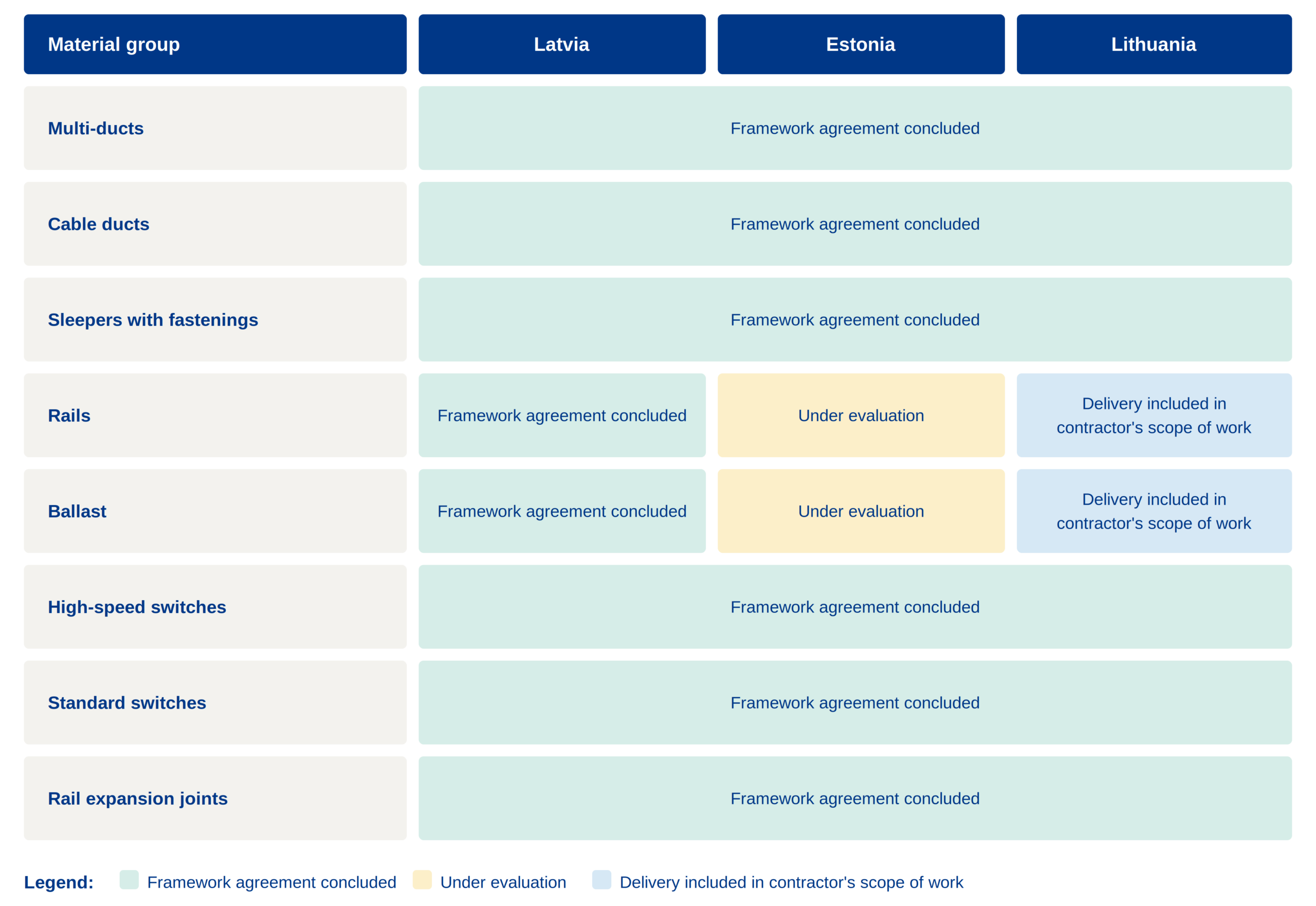
The consolidated procurement agreement provides the possibility to ensure construction material deliveries for all three Baltic states, while preserving each country’s right to independently decide on the use of the agreement. For example, in the case of rail procurement, Latvia has signed the agreement, Estonia has confirmed in writing its readiness to join, while Lithuania has chosen to procure rails separately. Actual demand for rails is not expected before 2028, therefore each country can make decisions best suited to its implementation pace and priorities.
Differences in volumes: why the comparison is not equivalent
To understand why comparing consolidated procurement with individual spot procurements is incorrect, it is important to recognize the difference in scale. The Rail Baltica consolidated rail framework agreement provides for deliveries amounting to several thousands of tonnes over a seven-year period. By comparison, AS “Latvijas dzelzceļš” has procured approximately 4,800 tonnes of rails during the last three years, consisting of 1,927 tonnes in 2024, 2,168 tonnes in 2025, and 723 tonnes in 2026, which corresponds to around 6% of the consolidated framework agreement volume for Latvia. Excluding the 2024 procurement, this share decreases to approximately 3.5%. Similarly, in Lithuania, the separately procured volume by LTG Infra corresponds to around 3.5% of the consolidated framework agreement volume for that country. Thus, in both Latvia and Lithuania, the volume of separate procurements is less than 5% of the consolidated framework agreement volume.
Comparing a small, one-time procurement with a seven-year framework agreement covering more than twenty times the volume and including price guarantees, supply security, and quality requirements for the entire period is not appropriate. These are fundamentally different instruments with different commercial logic.
How price differences arise in different rail procurements
Public comparisons have been made between the Rail Baltica consolidated rail procurement and the recent AS “Latvijas dzelzceļš” procurement. However, these procurements are based on different technical and commercial principles, and their prices reflect different products, guarantees, and risk allocation structures.
A significant difference lies in the technical specification of the rails. The “Latvijas dzelzceļš” procurement provides for 25-metre rails, whereas the Rail Baltica project requires 50-metre rails, which are the international standard for modern high-speed railway lines. Longer rails reduce the number of weld joints per kilometre by half, which directly affects lifecycle costs, vibration levels, and maintenance requirements over the coming decades, as well as operational safety. Every weld joint is a potential point of fatigue and damage, therefore reducing their number by half significantly improves track safety. This is especially critical for a high-speed railway line where train speeds reach 249 km/h. The Rail Baltica framework agreement also includes a longer warranty period and broader supplier responsibility for material quality throughout the duration of the agreement.
Before launching the consolidated procurement, RB Rail conducted market consultations with potential suppliers, during which technical specifications, contract structure, and risk allocation issues were discussed. The opinions received were evaluated and, where compatible with the project’s technical and legal requirements, incorporated into the procurement documentation. At the same time, certain supplier proposals that would have reduced supply security requirements or shifted market risk from supplier to contracting authority were not accepted.
The contract structures also differ. In one-time procurements, the supplier receives a specific order with a defined volume and delivery deadline. By contrast, the Rail Baltica consolidated procurement is a long-term framework agreement in which the supplier must ensure delivery readiness and manufacturing capacity availability over several years. The framework agreement sets higher qualification and financial security requirements for suppliers, reflecting the nature of long-term international infrastructure projects, and are included in the overall contract price.
What a fixed-price seven-year agreement means and how risks are allocated
In recent years, the prices of steel and other construction materials in international markets have fluctuated significantly. A seven-year framework agreement with a predefined pricing mechanism and indexation procedure provides the contracting authority with greater predictability and planning security over the long term.
It is important to emphasize the asymmetry of risk allocation. In a separate “spot” procurement, market risk remains almost entirely on the contracting authority’s side. If steel prices rise in coming years, each subsequent procurement must be carried out at the market price of that time, and the contracting authority assumes all price fluctuation risks. By contrast, under the consolidated framework agreement, a significant portion of market risk is transferred to the supplier, who must ensure deliveries for seven years at a previously agreed price regardless of changes in market conditions. This means that the contracting authority is purchasing not only the material itself, but also price stability, supply security, and protection against market fluctuations over a longer period.
In conclusion, the framework agreement secures not only material supply, but also long-term manufacturing capacity reservation and delivery priority for Rail Baltica project over several years. Such industrial capacity reservation has obviously some intrinsic commercial value and is not comparable to a one-off spot purchase. Short-term spot procurements may occasionally achieve lower prices under specific market conditions, for example where suppliers seek to utilise temporary excess production capacity. But it is not sustainable in the long term for a large project like Rail Baltica. Furthermore, a long-term fixed pricing mechanism inevitably includes a risk premium reflecting the supplier’s assumption of future market volatility. In practice, RB Rail is purchasing predictability and protection against future price escalation that a spot market purchase strategy does not provide. Direct comparison between procurement prices agreed at different moments in the steel market cycle can be misleading. Spot procurement prices reflect immediate market conditions at a single point in time, whereas the Consolidated Materials framework agreement establishes a long-term pricing structure covering future years during which market conditions may materially change. Past experience shows that infrastructure projects relying exclusively on spot procurement mechanisms face significantly higher exposure to shortages, delivery delays, and extreme price volatility all delaying the Project and generating significant additional costs. So a direct comparison between the two procurement mechanisms requires careful consideration of the substantially different technical, commercial, and risk allocation structures that govern these two procurement models.
On strengthening project governance
RB Rail welcomes the decision to strengthen coordination of the Rail Baltica project and the increased role of the Prime Minister in project oversight. Initiatives aimed at increasing procurement management transparency are also supported.
Status of Rail Baltica consolidated procurement framework agreements (as of May 2026)