

On Monday, 19 January, the European Court of Auditors published an update of its 2020 report on EU transport megaprojects. The report examines eight major infrastructure projects across thirteen EU Member States, including Rail Baltica. The Court stated that large-scale TEN-T projects require a clearly defined timeframe and predictable financing in order to meet their objectives. In this context, the successful delivery of Rail Baltica Phase I by 2030 remains conditional on the availability of sufficient EU funding under the upcoming Multiannual Financial Framework (MFF) for 2028–2034.
Audit findings reflect previously identified project risks
RB Rail notes the conclusions of the European Court of Auditors and agrees with them, as they are in line with the risks previously identified, analysed and publicly communicated by the project implementers. The Court reports that Rail Baltica’s estimated total cost for the full project scope has increased to €23.8 billion (2023 prices), compared with the initial official estimate of €5.8 billion (2017 values) and the €7 billion risk-adjusted estimate presented in the Court’s 2020 report.
Overall, the cost growth is largely attributable to the limited maturity of early estimates and subsequent design and scope refinements, in line with the findings of the 2024 joint audit by the supreme audit institutions of Estonia, Latvia, and Lithuania. Initial cost projections were based on preliminary value-engineering assumptions and were later replaced by more accurate estimates as the project progressed to the master design stage. Cost increases were further driven by scope expansion, updated technical, safety, and military mobility requirements, and significant external pressures, including approximately 40% cumulative inflation in the Baltic states between 2017 and 2023, higher construction and energy prices, supply-chain disruptions, and the impact of Russia’s war against Ukraine.
Rail Baltica faces challenges typical of European megaprojects
The European Court of Auditors notes that large European infrastructure projects deviate from their original plans by more than a decade on average. Against this background, the shift of the deadline to the current new target of 2030 remains within the range typically observed for projects of this scale and complexity. However, reaching this goal is subject to several preconditions, foremost of which is availability of adequate financing.
Rail Baltica is a project of exceptional scale and complexity, developed simultaneously across three countries as a new, greenfield, European-standard railway, rather than an upgrade of existing infrastructure. It involves common technical, safety and interoperability standards and an unusually high number of cross-border interfaces and stakeholders. Its geographical and geopolitical context, being located close to the EU’s eastern border and an active war zone, has amplified the impact of inflation, energy prices, supply-chain volatility and security requirements compared to many other TEN-T projects.
Tangible progress in project implementation
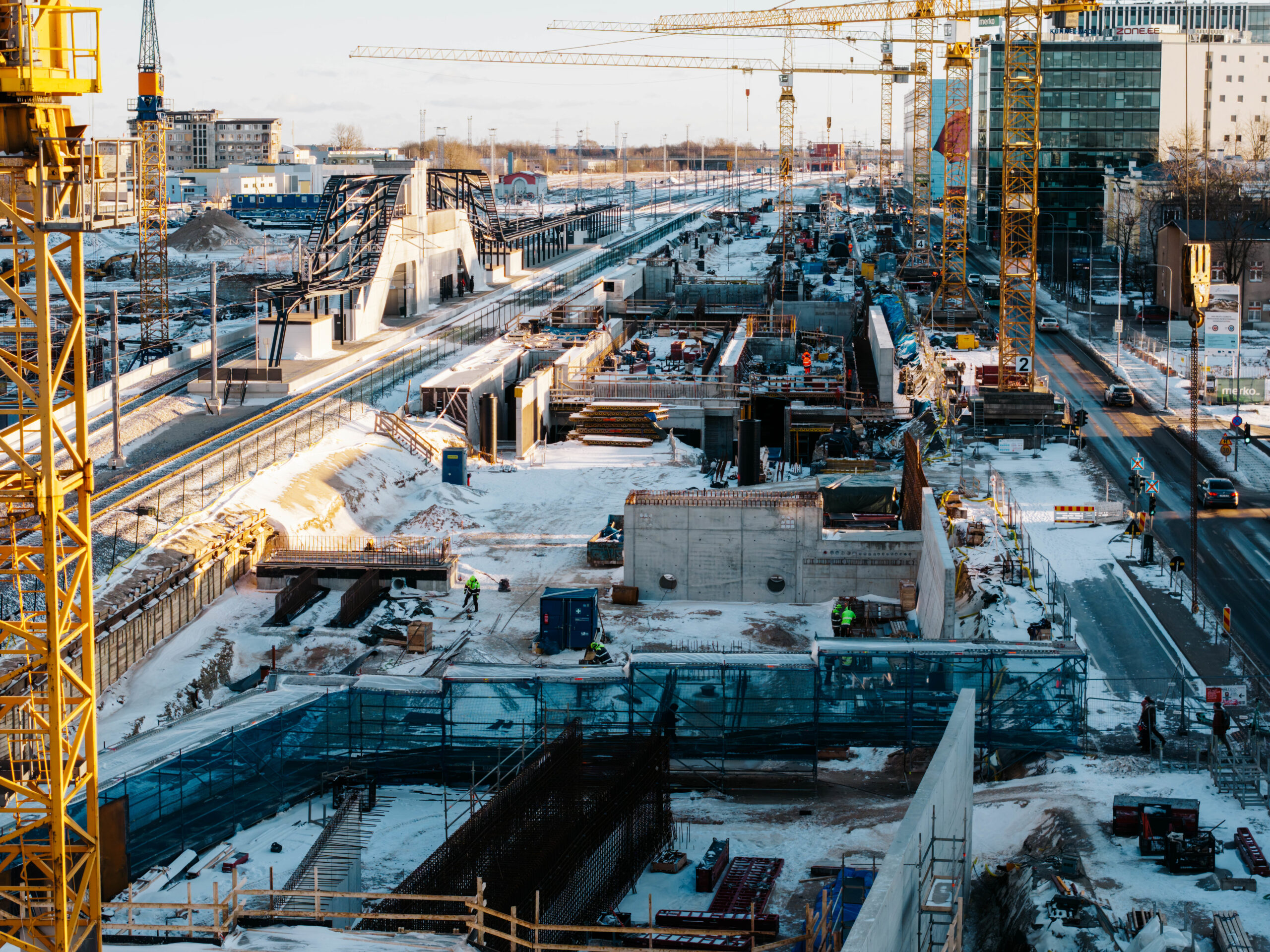
Rail Baltica has progressed from planning into the construction phase, with implementation now well advanced across all three Baltic states. In Estonia, signed construction contracts cover approximately 202 km of the 213 km mainline, and more than 100 km is under active construction. In Latvia, full-scale works are ongoing on the priority southern section, with approximately 30–35 kilometres transferred to the contractor, alongside continued construction at Riga Central Station and Riga Airport. In Lithuania, 114 km of the mainline is currently under construction with also track laying commencing on the first 9 km.
Financing outlook and risk mitigation
With regard to the risk of cost escalation, the availability of sufficient financing constitutes a fundamental prerequisite for the timely implementation of the project. At present, Rail Baltica Phase I activities are being carried out strictly within the limits of secured funding, without the assumption of financial commitments that are not fully covered.
To safeguard project continuity and mitigate the risk of further cost increases, it is essential to ensure adequate, stable, and predictable funding under the Connecting Europe Facility (CEF) within the 2028–2034 Multiannual Financial Framework. Sustained EU-level financial support is indispensable for maintaining implementation momentum, enabling coordinated cross-border delivery, and fully realising Rail Baltica’s strategic importance in the current geopolitical context, as a core component of the TEN-T network and a significant contributor to EU military mobility, deterrence on the eastern flank, climate objectives, and European connectivity.
See the full report here.