
Rail Baltica is a railway infrastructure megaproject that spans across several countries. The depth of skills and expertise required to successfully execute a greenfield project of this caliber is extensive and would not be possible without our diverse team of professionals.
Welcome back to our series, “Rail Baltica: The People Behind the Vision,” where we introduce you to the members of the Rail Baltica global project team. These individuals are the driving force advancing the Rail Baltica project with their professionalism, dedication, and passion for this project.
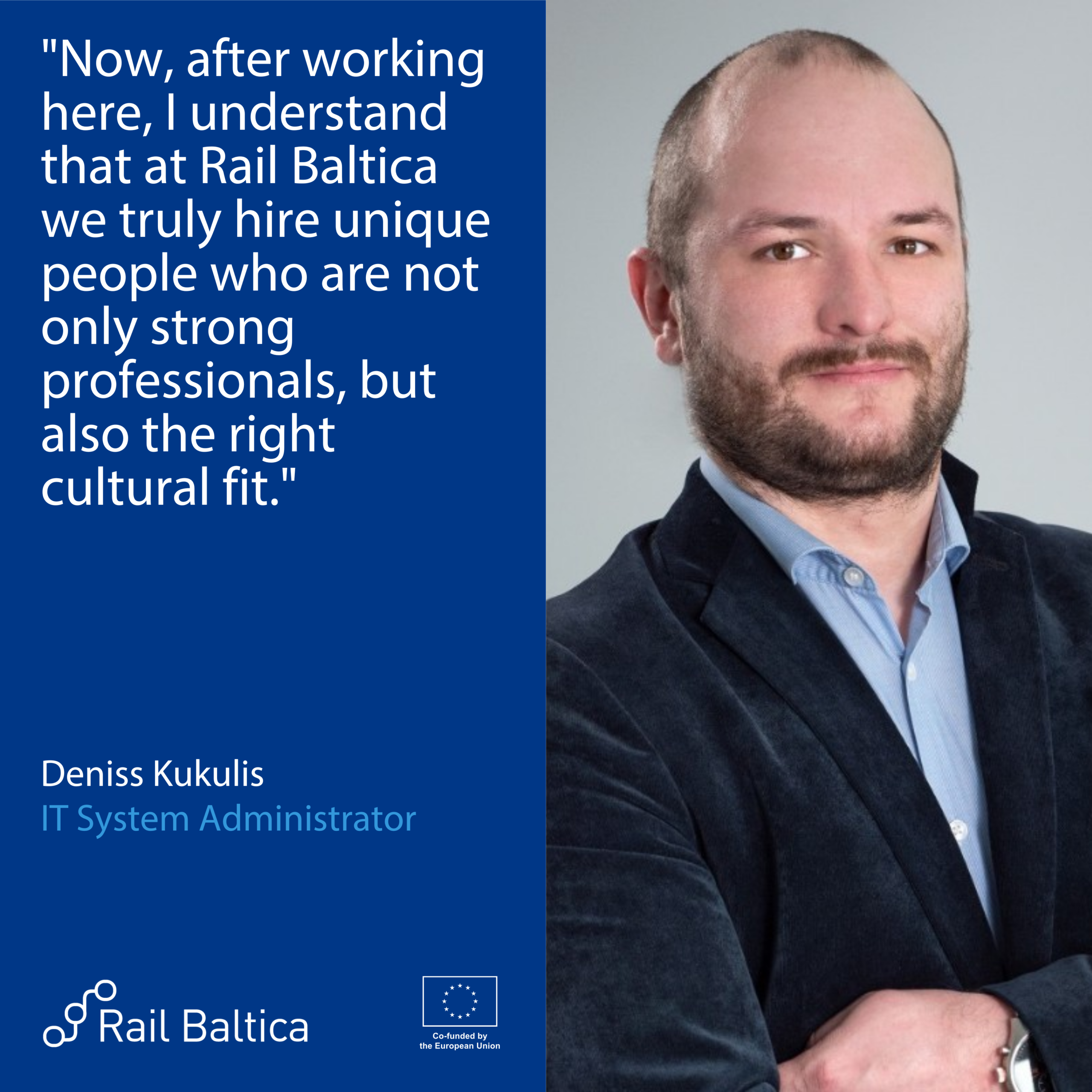
Deniss Kukulis, IT System Administrator, RB Rail AS
Deniss Kukulis works as an IT System Administrator at RB Rail AS, supporting colleagues and helping keep systems running smoothly. While users often see only the immediate support, much of his work happens behind the scenes by maintaining systems, ensuring security, and preventing issues before they arise. As he says, IT is not only a firefighter brigade. It is also a fire prevention brigade.
For Deniss, good teamwork is built on openness, respect, and small gestures that create a positive atmosphere, such as baking cakes for colleagues. He believes people should never hesitate to ask for help, because everyone knows only a small part of a much larger system.
What expectations did you have before joining Rail Baltica, and how have they changed?
After the initial interview, there was quite a long time between the next steps and feedback. I had applied for one position, and I thought I was a bit underqualified for another one. But it looks like life has a funny sense of humour, and maybe I simply had a bit of imposter syndrome.
At the time, I kept wondering why the process was taking so long.Now, after working here, I understand that at Rail Baltica we truly hire unique people who are not only strong professionals, but also the right cultural fit. What I once thought was slow, I now see as careful, thoughtful and trustworthy.
What part of your work is most critical, but often unseen?
Users usually see me through the lens of user support, and of course they know they are not the only ones who need help right now. The thing is, it takes a lot of time to maintain, patch, secure, discover, figure things out, learn, ask for help, dig through forums, and drink an unlimited supply of coffee. And what does the user see from their perspective? That everything works the same way as yesterday. IT is not only a firefighter brigade. It is also a fire prevention brigade.
What situation recently made you stop and think differently?
Not a recent one, but something I discovered a long time ago. Usually people who walk into our cabinet have an issue with technology, access, or something that can be plugged into electricity. And a lot of people start their story with: “I’m sorry, I’m so dumb, I need help…” and then explain the issue.
I will tell you a secret. In my whole career, a dumb person has never come to my office. I have seen people who are lost, confused, panicked, shy or frustrated, but never dumb.
You just don’t know one small part of a very large system, and that part is not working for you. I also have no clue how 90% of what our company does works, and I don’t need to. I am surrounded by professionals in their respective fields.
So please do not be afraid to ask for help. We are here for you.
What is one important lesson this project has taught you?
Urgency is relative. When someone says “it’s urgent,” it is important that everyone involved agrees that it is truly urgent, agrees on the timeframe and priorities, and understands the possible solutions and our capacity.
Otherwise, things that were supposed to be done “yesterday” sometimes end up not being done at all.
What does good teamwork mean to you in your daily work, and how do you contribute to a positive team culture?
I have a monthly 20-euro budget for cakes that I bake for my team. It is nothing that would change my life drastically, but I know colleagues are a bit happier to work with when they know a cake is coming.
My logic is simple. Hungry people are usually more stressed to work with. If we disagree, that is perfectly fine, but I expect proper arguments and not emotions simply because someone is hungry.
How do you usually recharge outside of work?
Outside of work I like hiking, camping and travelling. I am inspired by the traveller Fjodor Konyukhov. He spent his whole life exploring the world, with expeditions to the Arctic and many other places. In one interview the host listed his achievements for several minutes and then asked, “Why do you travel so much?” His answer was simple: “I am bored at home.” When I am at home, I usually practice bass guitar, play board games, or host Dungeons and Dragons sessions.
What advice would you give to someone considering joining Rail Baltica today?
This is advice I gave to our new IT colleague. If you are in, give yourself time to breathe. A lot of people have already confirmed that you are at the professional level needed to get things done here, and that means you have the personal qualities to succeed.
One step at a time. Be honest, and be willing to see Rail Baltica done by all of us. It is that simple.