
Rail Baltica is a railway infrastructure megaproject that spans across several countries. The depth of skills and expertise required to successfully execute a greenfield project of this caliber is extensive and would not be possible without our diverse team of professionals.
Welcome back to our series, “Rail Baltica: The People Behind the Vision,” where we introduce you to the members of the Rail Baltica global project team. These individuals are the driving force advancing the Rail Baltica project with their professionalism, dedication, and passion for this project.
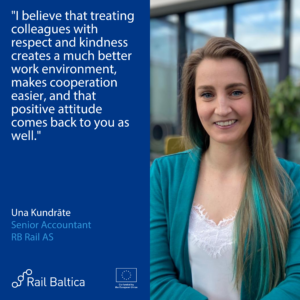
Una Kundrāte, Senior Accountant, RB Rail AS
Una Kundrāte works as a Senior Accountant at RB Rail AS, bringing both professionalism and a people-focused approach to her work. For Una, good teamwork means building genuine connections, treating colleagues with respect, and fostering an atmosphere where challenges can be tackled together and successes shared.
What expectations did you have before joining, and how have they changed?
To be honest, I expected this to be more routine work, which was exactly what I felt I needed after a couple of exhausting years in business centres. However, these six years have been anything but routine and have gone by like a high speed train. The work has been much more dynamic and challenging than I expected, but at the same time very exciting.
Despite accounting typically being a strict rule based field, working at RB Rail has never felt like “inside the box” work. The project is constantly evolving, with new systems, processes, and ways of working, which keeps things interesting and pushes you to adapt and grow professionally.
Over time, I have also developed a much stronger belief in the importance of the project itself. Working on something of this scale and significance for the Baltics and Europe gives an additional sense of purpose, even if you originally came hoping for quiet office work.
What decision or task do you regularly handle that has a big impact?
My work does not have a significant immediate impact on the project as such, but I do believe that at the end of each month I make everyone a little bit happier by doing what I do, and that makes me feel very good about my work. Hopefully, it also has some positive impact on the project, as happy people tend to be more productive.
For those who don’t know who I am, I work with payroll, though sometimes I feel like a nurse that you can tell your troubles and aches to.
How do you stay focused and motivated during complex or high-pressure periods, and what is a challenge you have faced on the project that you successfully overcame?
I think accounting comes with a very clear sense of responsibility, as the work we do affects many people across the company. Deadlines are an important part of the job, and staying organised and supportive as a team helps us keep everything running smoothly.
What helps me most is that I genuinely enjoy both my work and the people I work with. I believe that treating colleagues with respect and kindness creates a much better work environment, makes cooperation easier, and that positive attitude comes back to you as well.
How has working on Rail Baltica shaped you professionally?
I think the biggest impact on me has come from my colleagues in the Finance and Economics Department. Their unique personalities, life experiences, and professionalism have taught me a lot about myself and reshaped my views on how both work and personal life can change for the better, even when you feel stuck in your routine.
I have never encountered such a strong drive for improvement in every area of life as I have seen in my colleagues. Not all lessons have been easy, but many of them were important and valuable, and I truly appreciate the time spent together.
Working across all three Baltic states has also taught me a lot about different communication styles and ways of working. Over time, those differences have become something I value, as they bring new perspectives and help strengthen collaboration across the project.
What does good teamwork mean to you in your daily work, and how do you contribute to a positive team culture?
Cliché as it may sound, people quite often spend more time with colleagues than with their families, which in my case is 100% true, so having good relationships within your team seems essential to me. You don’t always have to be extra friendly with everyone, but being approachable helps in daily work, as clarifying uncertain topics takes a lot less time than correcting mistakes.
Mutual respect is also very important in reaching goals, as letting someone express their opinion is just as important as stating yours, and you might end up learning a thing or two that will help you later on. I might be a bit too friendly, as in some cases it does not take long for me to start inviting colleagues to events I want to attend or just randomly chatting with them about how things are going.
I believe that no one understands your problems better than your colleagues, as most of them tend to be work related anyway, and shared problems somehow start feeling a lot smaller, especially if you can have a good laugh about them. You can not always fix everything, but sometimes it is the thought that counts, so I keep a bowl of sweets near me in case someone is feeling down and, for extreme cases, some “magic rocks” that I might let you hold for a while.
How do you usually recharge outside of work?
The most common activity for my recharge is going on hikes. Physically, they are exhausting, but they really help clear your head and make room for better thoughts and new ideas. My go to places are mostly along the seashore or through forests, but they must always end in a place where you can get yourself a nice treat.
I recommend the route from Gauja station to Saulkrasti station. It is a 20 km walk mostly along the seashore, though be careful as there is also a slightly creepy nudist beach, that ends at the bakery “Bemberi” near Saulkrasti railway station. If you visit the bakery, try their éclairs with white filling.
I also participate in marathons, though my limit is 10 km, as I am built like a Corgi. Still, I really enjoy the atmosphere and strangers cheering for you, especially if you look like you are about to fall. It makes me feel like humanity still has hope, and getting a medal doesn’t hurt either. This year I have signed up for five so far, including the ones in Riga and Tallinn.
I always have my “spirit animal” with me. It is a children’s toy I make, and it even has its own Instagram account, @mouzebear. When I have more time, like during Covid, I donate some of the toys to children’s hospitals and similar establishments, or make them as gifts for friends and colleagues who are improving our demography. This is also my excuse to travel both far and near, as @mouzebear always needs new pictures.
For a smaller recharge, I also do my own nails. I am not very talented, but good enough for myself, and it is an excellent way to avoid intrusive thoughts. I usually listen to an audiobook while doing it too. Currently, I am listening to Jurassic World by Michael Crichton.
What advice would you give to someone considering joining Rail Baltica today?
Go for it! But don’t expect it to be like anything you have experienced before. Rail Baltica is a unique project in both its scale and ambition, and being part of it gives you the opportunity to contribute to something that will shape the region for generations to come.